Why Lead Generation for Construction Companies Is Harder Than It Looks
Lead generation for construction companies is the process of attracting and converting potential clients into paying customers — and it's one of the biggest challenges contractors face today.
Here are the most effective ways construction companies generate leads:
- Optimize your Google Business Profile for local search visibility
- Run Google Ads and Local Services Ads to capture high-intent searches
- List on industry-specific lead aggregator platforms to increase your reach
- Build a referral program to turn happy clients into a lead source
- Publish helpful content and blog posts to attract organic traffic
- Network with architects, GCs, and HOAs for warm introductions
- Use a CRM with automation to follow up fast and nurture leads
Most contractors get work through word of mouth — until that well runs dry. Without a steady pipeline, you're stuck in a feast-or-famine cycle: scrambling for the next job the moment the current one wraps up.
The problem isn't a lack of options. It's the opposite. There are dozens of lead sources, platforms, and strategies competing for your attention and budget. Knowing which ones actually work — and for what type of contractor — is what separates a predictable business from a stressed one.
The average construction company spends $280 per lead. That's a real cost, and it adds up fast if you're chasing low-quality inquiries or using the wrong channels for your niche.
This guide breaks down the best construction lead sources, compares your options honestly, and helps you build a system that fills your calendar without burning your budget.
I'm Chris McVey, Founder & CEO of On Deck Marketing, a Virginia-based agency that helps contractors build predictable, revenue-focused lead generation systems. My work in lead generation for construction companies spans local SEO, paid advertising, CRM automation, and sales process design — focused entirely on measurable results, not vanity metrics. In this guide, I'll walk you through exactly what's working right now so you can stop chasing ghosts and start closing real jobs.
Introduction: Defining Your Niche and Lead Types
Before you spend a single dollar on lead generation for construction companies, you have to know who you are chasing. If you try to build everything for everyone, you usually end up with a calendar full of "tire kickers" and low-margin repair jobs.
Finding Your Niche and Buyer Personas
Success starts with a niche. Are you a high-end custom home builder in Charlottesville, or do you specialize in rapid roof replacements in Harrisonburg? Identifying your Buyer Personas is critical. For example, a retiree in Staunton looking for a multi-level deck has very different motivations than a young family in Fishersville needing a kitchen remodel. When you narrow your focus, your marketing becomes a magnet rather than a megaphone.
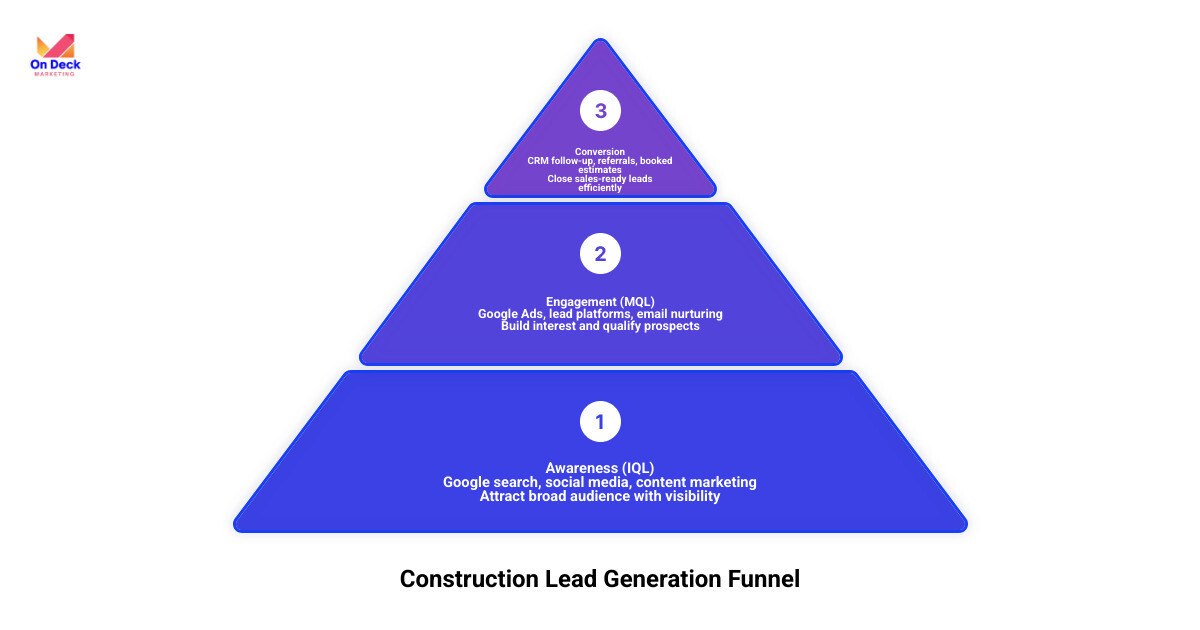
Understanding IQL vs. MQL
Not all leads are created equal. We categorize them into two main stages:
- Information Qualified Leads (IQL): These folks are at the top of the funnel. They are searching for "how much does a basement remodel cost?" or "best siding materials for Virginia weather." They aren't ready to hire yet; they need education.
- Marketing Qualified Leads (MQL): These are the "hot" leads. They’ve downloaded your pricing guide, requested a quote, or found you through a Google Business Profile search. They have a specific project and a timeline.
According to industry research on lead nurturing, companies that master the art of following up with these leads generate 50% more sales-ready prospects at a 33% lower cost. If you ignore the IQLs, you lose the chance to build trust before they ever reach the "buying" phase.
Organic Lead Generation for Construction Companies
Organic lead generation is the "long game," but it offers the highest ROI over time. It’s about being found when a homeowner in Waynesboro or Stuarts Draft pulls out their phone and searches for a local pro.
Local SEO: The Foundation of Lead Generation for Construction Companies
If you aren't on the first page of Google, you basically don't exist. Research shows that only 0.63% of people ever click to the second page of search results. To dominate locally, you need a strategy for unrivaled SEO lead generation.
- NAP Consistency: Ensure your Name, Address, and Phone number are identical across Bing Places, major business directories, and Facebook Business.
- Google Business Profile (GBP): This is your digital storefront. An optimized profile can boost physical visits by 70%. We recommend posting photos of your local projects in Verona or Staunton weekly. For a deep dive, check out our guide on how to set up and optimize your GBP.
- Location Pages: Create specific pages on your site for every town you serve. A page titled "Custom Home Additions in Charlottesville, VA" will rank much better than a generic "Services" page.
Content Marketing for Lead Generation for Construction Companies
Content marketing brings in three times more leads than traditional methods while costing 62% less. It’s about proving you’re the expert before you even meet the client.
- Project Galleries: High-quality "Before and After" photos are the ultimate social proof.
- Case Studies: Don't just show the photo; tell the story. Explain how you solved a structural issue for a client in Fishersville.
- Educational Blogs: Write about what you know. "5 Things to Ask a Virginia General Contractor Before Signing" is a great way to capture IQLs.
- Lead Magnets: Offer a "2024 Home Remodeling Budget Calculator" in exchange for an email address. This allows you to nurture the lead until they are ready to build.
Paid Advertising Strategies
Sometimes you can’t wait for SEO to kick in. You need jobs now. This is where paid advertising comes in. However, the "pay-per-lead" world can be a minefield of shared leads and high costs.
Comparing Lead Models
| Feature | Third-Party Lead Aggregators | Subscription/Direct Ads (e.g., Google Ads) |
|---|---|---|
| Exclusivity | Often shared with 3+ contractors | 100% Exclusive to you |
| Cost | Fixed price per inquiry | Variable (Pay per click) |
| Control | Low (Platform chooses the lead) | High (You choose keywords) |
| Trust | Leads often feel "vetted" by platform | Leads trust your brand directly |
Google Ads and LSAs
For immediate results, Paid Ads Management is the way to go.
- Google Local Services Ads (LSAs): These are the "Google Guaranteed" ads at the very top of the page. You only pay when a customer actually calls or texts you. Verified pros receive 35% more inquiries than those without the badge.
- Search Ads: These allow you to target specific high-intent keywords like "emergency roof repair Waynesboro."
- Social Media Retargeting: Ever visit a website and then see their ads on Facebook for a week? That’s retargeting. It keeps your construction company top-of-mind for homeowners who are still in the "thinking about it" phase.
Leveraging CRM and Marketing Automation
The biggest mistake contractors make isn't a lack of leads—it's a lack of follow-up. A study found that the chances of connecting with a prospect drop tenfold if you don't respond within the first hour. If you're on a job site in Stuarts Draft, you can't always answer the phone. That’s where automation saves the day.
Lead Nurturing and Sales Automation
Using the ODM Business Suite SaaS Software, you can set up "Auto-Responders." When a lead comes in from a lead generation service or your website, they get an immediate text: "Hi! This is Chris from On Deck Marketing. I’m on a job site right now, but I’d love to talk about your kitchen project. Can you send a photo of the space?"
This keeps the lead from calling your competitor while you're busy.
ROI Tracking
You must know your numbers. If you spend $1,000 on a lead platform and get $20,000 in revenue, that’s a win. If you spend $1,000 on a low-quality source and get $0 because the leads were "ghosts," you need to pivot. A CRM allows you to track every dollar from the first click to the final invoice.
Frequently Asked Questions about Construction Leads
What is the difference between IQL and MQL in construction?
An Information Qualified Lead (IQL) is someone researching possibilities (e.g., "types of flooring"). A Marketing Qualified Lead (MQL) is someone ready to talk business (e.g., "requesting a flooring estimate"). You nurture IQLs with blogs and newsletters; you call MQLs immediately.
How much does the average construction lead cost?
The industry average is $280 per lead. However, this varies wildly. A simple handyman lead might cost $20, while a high-end commercial lead could be significantly higher. The key is measuring your Cost Per Acquisition (CPA) —how much you spend to actually land the contract, not just get the phone to ring.
Should contractors buy leads from aggregator websites?
It depends on your stage of business. Third-party lead platforms can be great for filling a dry pipeline. However, many contractors find that "buying" leads is a race to the bottom on price. Using these sites to supplement your own SEO and Web Design is usually the best long-term strategy.
Conclusion
Generating quality lead generation for construction companies isn't about luck; it's about a repeatable system. By combining the "long-term" power of local SEO and reviews with the "short-term" speed of paid ads and automation, you can create a business that stays busy year-round.
81% of consumers need to trust a brand before they buy. Whether you are networking with HOAs in Charlottesville or showcasing your 5-star reviews on your business profile, every touchpoint matters.
At On Deck Marketing, we specialize in taking the guesswork out of this process. Our Virginia-based team understands the local market from Staunton to Harrisonburg. We don't just want to get your phone to ring; we want to help you build a profitable, sustainable business.
Ready to stop chasing ghosts? Check out our Programs and Prices and let's build a 90-day growth plan that works for you. Or, if you're looking for more industry-specific tips, you can become a StrongPro to stay ahead of the latest trends.